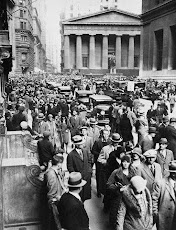
In down turned economic times, competition for scarce resources and territory becomes intensified. This was true during the Great Depression when "Depression Desperadoes" gangs and thugs began crowding each other out when the economy went into a tailspin, and fewer dollars were available from their criminal enterprises. There is another similarity to the Great Depression era -- the old familiarity and corruption that some police and criminals seemed to enjoy together came to an about face and street war with the creation of the FBI and the battle royale that ensued. This phenomenon appears to be repeating itself in our era south of the US border.
Consider what is happening south of the US border in Mexico. Mexico has been hit by a brutal crime wave as rival drug gangs step up attacks against each other and the police. More than 4,000 people have died this year in violence connected to criminal gangs in Mexico. The intensity of violence rivals the violence levied by the Columbian cartels bringing full the mean streets of brutality, violence, and fear. The gangs are using typical intimidation tactics used in trafficking that involve stark displays of violence and murder. This past week, a Mexican newspaper reporter working in Juarez along the U.S. border was shot by armed men that killed the reporter on his way to work Thursday. From the press report, "A recent series of drug-related violence has left at least seven people dead in the northern border city. Police said Monday that a burned and mutilated body was dumped in front of a police station. Authorities say police later found two men and two women shot to death outside a medical clinic. The Associated Press reported that a woman's body was found in a trash bag, while a bystander was killed in a car crash caused by a police chase. On Monday, Mexican President Felipe Calderon named a former federal lawmaker, Fernando Gomez Mont, to replace Interior Minister Juan Camilo Mourino, who died in a plane crash last week in Mexico City.Mourino was a central figure in Mr. Calderon's government and helped lead a campaign against mounting violence by drug cartels. " Read the original article -- http://www.voanews.com/english/2008-11-13-voa45.cfm
Historically, thinking of lessons learned from the last great crime wave that broiled during the Great Depression, only when the federal government rationalized the illegal markets and stripped organized crime from their prohibition-led intoxicant sales did the situation turn around. Additionally, and not to be ignored, it took updated police methods along with new technologies to rival those being used by the criminal gangs to turn around the problem then in order to overcome the not insignificant local corruption problems of the era.
Friday, November 14, 2008

Thursday, November 13, 2008
Economic misery and Crime Waves -- Japanese elderly committing increased number of crimes
Not since 1991 during the Japanese economy meltdown has crime peaked among elderly -- no, not victimization of elderly, but elderly offenders involved in numerous crimes such as pick pocketing, shop lifting, theft. Bloomberg reports that "The latest [Japanese] elderly-crime wave comes after markets plunged and as Japan frets about a return of deflation. In 2007, a total of 48,605 elderly people were arrested or investigated for crimes other than traffic offenses, a fourfold jump from the early '90s. " Besides theft and shoplifting, increased criminal activity by elderly includes acts of embezzlement and assaults. Reasons cited for the increase include money troubles and isolation from families. The articles commentator, William Pesek comments, "You don't need to be a criminal psychologist to see how this touches on many of the economic challenges facing Japan's 127 million people. It gets at everything from the gap between rich and poor to pressure on executives to how the government is dithering as the population ages.
``Elderly crime is a serious problem that our society must shoulder in the years to come,'' the government report said. ``With baby boomers becoming elderly within five years, we have reached a state where we must make a fundamental review of anti- crime measures in a fast-aging society.'' See the full article at: http://www.bloomberg.com/apps/news?pid=newsarchive&sid=am..8hAE3mPI
Another article on this topic -- Shoplifting wave points to plight of elderly Japanese
Isolation, poverty set to drive elders' arrests above teens', read at http://www.chicagotribune.com/news/nationworld/chi-japanese-thefts_dec03,0,939818.story
``Elderly crime is a serious problem that our society must shoulder in the years to come,'' the government report said. ``With baby boomers becoming elderly within five years, we have reached a state where we must make a fundamental review of anti- crime measures in a fast-aging society.'' See the full article at: http://www.bloomberg.com/apps/news?pid=newsarchive&sid=am..8hAE3mPI
Another article on this topic -- Shoplifting wave points to plight of elderly Japanese
Isolation, poverty set to drive elders' arrests above teens', read at http://www.chicagotribune.com/news/nationworld/chi-japanese-thefts_dec03,0,939818.story
Crime Spike in Russia on Individuals Holding Cash
With Russian citizens fearful of another financial failure of the banking system, and increased economic uncertainty in the political climate, more Russian citizens have withdrawn deposits from banks and are carrying greater amounts of cash on them. This has resulted in the unintended consequence of increasing crime opportunity for criminals that are now targeting individuals believed to be carrying cash, or retrieving cash from banks, or storing cash at home. Reported yesterday by Bloomberg, "Investors have withdrawn at least $140 billion from Russia since the start of August, BNP Paribas SA estimates, because of slumping commodities prices, the war with Georgia and the seizing up of global capital markets." This same type of crime opportunity risk could be seen in other parts of the world where individuals have clamoured for hard assets such as gold, silver, other precious commodities, and cash. Listed below are excerpts from the quoted article appearing in Bloomberg at http://www.bloomberg.com/apps/news?pid=newsarchive&sid=aEFWvrUJRLsk
Crime Wave Hits Moscow as Russians Carry Cash in Credit Crunch
By Sebastian Alison, Nov. 12 (Bloomberg) -- Moscow has been hit by a crime wave as ever more Russians, distrusting the banking system during the global credit crunch, are withdrawing their savings and carrying large amounts of cash around, making them easy prey for thieves.
Yesterday alone, police registered four separate thefts from car drivers, of amounts ranging from 300,000 rubles to 3 million rubles ($10,900 to $109,000) state broadcaster Vesti-24 said in a report posted on its Web site. ``Police have noted that since the start of the crisis, such crimes have become more common,'' Vesti said. ``This is because people are carrying large amounts of cash. Some are changing it into foreign currency. Others are withdrawing it from banks and taking it home. Criminals are taking advantage of this.'' At 1:30 p.m. yesterday, four people attacked the driver of a Jeep Grand Cherokee which had stopped at a traffic light, injuring him with a hammer and baseball bats, before making off with a bag containing 300,000 rubles, police said. At about the same time, three men grabbed a bag with 3 million rubles in it from a 32-year-old sitting in a car, before making off in another car, according to police.
Shooting. Yesterday evening three men stopped a car in the city center driven by a 45-year-old businessman and snatched a bag from him with 500,000 rubles. At about 10 p.m. a group of five men shot a 32-year-old man as he got out of his car, wounding him, and escaping with ``a large amount of money,'' police said.
Crime Wave Hits Moscow as Russians Carry Cash in Credit Crunch
By Sebastian Alison, Nov. 12 (Bloomberg) -- Moscow has been hit by a crime wave as ever more Russians, distrusting the banking system during the global credit crunch, are withdrawing their savings and carrying large amounts of cash around, making them easy prey for thieves.
Yesterday alone, police registered four separate thefts from car drivers, of amounts ranging from 300,000 rubles to 3 million rubles ($10,900 to $109,000) state broadcaster Vesti-24 said in a report posted on its Web site. ``Police have noted that since the start of the crisis, such crimes have become more common,'' Vesti said. ``This is because people are carrying large amounts of cash. Some are changing it into foreign currency. Others are withdrawing it from banks and taking it home. Criminals are taking advantage of this.'' At 1:30 p.m. yesterday, four people attacked the driver of a Jeep Grand Cherokee which had stopped at a traffic light, injuring him with a hammer and baseball bats, before making off with a bag containing 300,000 rubles, police said. At about the same time, three men grabbed a bag with 3 million rubles in it from a 32-year-old sitting in a car, before making off in another car, according to police.
Shooting. Yesterday evening three men stopped a car in the city center driven by a 45-year-old businessman and snatched a bag from him with 500,000 rubles. At about 10 p.m. a group of five men shot a 32-year-old man as he got out of his car, wounding him, and escaping with ``a large amount of money,'' police said.
Tuesday, November 11, 2008
Falling off a bridge - by Ilene Dover, and search for a softer landing
This humorous children’s pun is riddled with satirical undertones of the current financial market and rapidly rising unemployment. The economy has indeed fallen off a bridge or cliff, and we have hope of a soft landing but there may be more rocks below. One of the primary reasons for our market collapse is the collective action of individuals and organizations who leaned over, whether it was credit liens, overreliance on cheap money, search for the next bubble, or jumping out of the market in an attempt to preserve capital, halting capital spending, curtailing credit extensions -- the collective action is a free fall for all.
Everyone is focused on self-preservation. Just two months into TARP, and the needs for TARP are greatly stretched – I hope the TARP is elastic as it might unravel. I find it more than ironic that the financial market prognosticators somehow think that the financial markets are more important than the real economy (e.g., strategic economic industries such as automotive, industry, infrastructure, etc), particularly where jobs are concerned. Ironically, banks can be nationalized far more easily than industries particularly when what is needed is economic backing, market confidence, and liquidity. Whereas nationalizing industries becomes more problematic in terms of nationalized industries being market responsive in terms of innovation, productivity, output, and inventory control -- and contrary to Say's Law, automobile supply does not create its own demand in today's environment. Preserving strategic industries, transforming industries, and forging new economies and by reference jobs are a vital requirement for the next administration.
Beyond supporting or retooling legacy industries, a new Congress and president might look to the past for guidance --- Consider the power and value of National Science Policy Goals -- it is frequently quoted that the initial funds spent on NASA to put a man on the moon returned 7:1 benefit for the economy in terms of jobs and economic stimulus. What other mutually beneficial science policy goals could be invested in with a 7:1 benefit or greater? Be it energy, environment, medicine, or transportation in terms of new bridges and roads? Regardless of the X factor multiple put on spending, there will be some left out of the jobs equation as their skills are not sufficient or no longer needed in the future economy. Significant investment in education and job re-training with real jobs at the end of course completion need to materialize in the coming plan.
Beyond transformational investment, there will be a need for additional jobs and criminal diversion programs. Many historical economists incorrectly look back on the Great Depression as a time when crime diminished statistically, and somehow they pass early judgment that there will be no spike in crime with a 2nd Great Depression (where we are headed). What is frequently missed in their analysis is the fact that the US government was heavily involved in one of the greatest crime control diversion programs during the great Depression where the government extracted unemployed, poor, inner city young men and placed them in distributed work camps called the CCC or Conservative Conservation Corps. Touted publicly as a jobs program for the economy, the real underbelly of the program served a crime control purpose to remove likely offenders and thereby reduce crime opportunity by providing work for the young male population at greatest risk for crime involvement.
From J A Pandiani's (1978), Crime Control Corps - An Invisible New Deal Program , "The extreme economic hardship and social dislocation of the Great Depression were widely expected to produce a crime wave of major proportions. From the mid-1920's until 1933, crime rates rose, but then the trend mysteriously reversed itself. Between 1933 and 1941, large numbers of poor young men were institutionalized in work camps far from population centers as part of the CCC relief program. They were thereby effectively removed from the crime-committing population. The crime control function of the CCC was probably intended, but remained unrecognized by the public. The expressed purpose of the program was to provide economic relief for enrollees and their dependents and to perform various conservation projects, such as flood control and reforestation. At its peak in 1935, CCC operated 2,650 camps with a total enrollment of over 500,000 men. Thus, it appears that from 1932 to 1940 between one-quarter and one-third of the Nation's poor young men were in the CCC. This failure to recognize the important social control function as well as the program's overall success must be attributed to its striking correspondence with American values and traditions surrounding free enterprise. "
As one looks more deeply into the underlying economic conditions of the current market collapse and the portended increased storm of economic misery, associated unemployment, and crime opportunity, there will be a need for preparation of a thoughtful crime control strategy to work alongside the other financial plans. To this end, this blog is dedicated – to focus rhetoric on the baneful economic consequences of the current situation, highlight likely future courses of market direction, and proactive solutions that might be recommended to create a softer landing, and avoid the rocks below.
Everyone is focused on self-preservation. Just two months into TARP, and the needs for TARP are greatly stretched – I hope the TARP is elastic as it might unravel. I find it more than ironic that the financial market prognosticators somehow think that the financial markets are more important than the real economy (e.g., strategic economic industries such as automotive, industry, infrastructure, etc), particularly where jobs are concerned. Ironically, banks can be nationalized far more easily than industries particularly when what is needed is economic backing, market confidence, and liquidity. Whereas nationalizing industries becomes more problematic in terms of nationalized industries being market responsive in terms of innovation, productivity, output, and inventory control -- and contrary to Say's Law, automobile supply does not create its own demand in today's environment. Preserving strategic industries, transforming industries, and forging new economies and by reference jobs are a vital requirement for the next administration.
Beyond supporting or retooling legacy industries, a new Congress and president might look to the past for guidance --- Consider the power and value of National Science Policy Goals -- it is frequently quoted that the initial funds spent on NASA to put a man on the moon returned 7:1 benefit for the economy in terms of jobs and economic stimulus. What other mutually beneficial science policy goals could be invested in with a 7:1 benefit or greater? Be it energy, environment, medicine, or transportation in terms of new bridges and roads? Regardless of the X factor multiple put on spending, there will be some left out of the jobs equation as their skills are not sufficient or no longer needed in the future economy. Significant investment in education and job re-training with real jobs at the end of course completion need to materialize in the coming plan.
Beyond transformational investment, there will be a need for additional jobs and criminal diversion programs. Many historical economists incorrectly look back on the Great Depression as a time when crime diminished statistically, and somehow they pass early judgment that there will be no spike in crime with a 2nd Great Depression (where we are headed). What is frequently missed in their analysis is the fact that the US government was heavily involved in one of the greatest crime control diversion programs during the great Depression where the government extracted unemployed, poor, inner city young men and placed them in distributed work camps called the CCC or Conservative Conservation Corps. Touted publicly as a jobs program for the economy, the real underbelly of the program served a crime control purpose to remove likely offenders and thereby reduce crime opportunity by providing work for the young male population at greatest risk for crime involvement.
From J A Pandiani's (1978), Crime Control Corps - An Invisible New Deal Program , "The extreme economic hardship and social dislocation of the Great Depression were widely expected to produce a crime wave of major proportions. From the mid-1920's until 1933, crime rates rose, but then the trend mysteriously reversed itself. Between 1933 and 1941, large numbers of poor young men were institutionalized in work camps far from population centers as part of the CCC relief program. They were thereby effectively removed from the crime-committing population. The crime control function of the CCC was probably intended, but remained unrecognized by the public. The expressed purpose of the program was to provide economic relief for enrollees and their dependents and to perform various conservation projects, such as flood control and reforestation. At its peak in 1935, CCC operated 2,650 camps with a total enrollment of over 500,000 men. Thus, it appears that from 1932 to 1940 between one-quarter and one-third of the Nation's poor young men were in the CCC. This failure to recognize the important social control function as well as the program's overall success must be attributed to its striking correspondence with American values and traditions surrounding free enterprise. "
As one looks more deeply into the underlying economic conditions of the current market collapse and the portended increased storm of economic misery, associated unemployment, and crime opportunity, there will be a need for preparation of a thoughtful crime control strategy to work alongside the other financial plans. To this end, this blog is dedicated – to focus rhetoric on the baneful economic consequences of the current situation, highlight likely future courses of market direction, and proactive solutions that might be recommended to create a softer landing, and avoid the rocks below.
Monday, November 10, 2008
Economic misery spreads -- portend of crime wave
Economic misery is spreading. Despite liquidity availability, credit has not made it to the marketplace, or in other words, few credit worthy enterprises or households remain, and credit remains tight. Crime is spiking in pockets all over. It surfaces in increased property crime and thefts, to more violent interactions in illegal drug trafficking. Here are some recent headlines from this week --
Mexico kidnap gang kills boy, 5, with acid
Times Online - UK
Experts say the crime wave reflects increased violence in the drug trade, in which 4000 have died in battles between cartels and the police this year.
Crimewave hits high street as recession bites
http://www.thisislondon.co.uk/standard/article-23584344-details/Crimewave+hits+high+street+as+recession+bites/article.do
>Credit crunch shoplifting rises by 36 per cent as economic downturn bitesTesco, the large Wal-mart style supermarkets chain has been hit by a shoplifting epidemic following the downturn in the economy. Essential items have become the most common target, suggesting that thieves are increasingly motivated by need rather than greed.Tesco caught more than 43,000 shoplifters in the first half of this year - an increase of 36 per cent on the same period in 2007.
Mexico kidnap gang kills boy, 5, with acid
Times Online - UK
Experts say the crime wave reflects increased violence in the drug trade, in which 4000 have died in battles between cartels and the police this year.
Crimewave hits high street as recession bites
http://www.thisislondon.co.uk/standard/article-23584344-details/Crimewave+hits+high+street+as+recession+bites/article.do
>Credit crunch shoplifting rises by 36 per cent as economic downturn bitesTesco, the large Wal-mart style supermarkets chain has been hit by a shoplifting epidemic following the downturn in the economy. Essential items have become the most common target, suggesting that thieves are increasingly motivated by need rather than greed.Tesco caught more than 43,000 shoplifters in the first half of this year - an increase of 36 per cent on the same period in 2007.
Thursday, November 6, 2008
Economic misery worsens -- unemployment notices
It is becoming painfully obvious that the financial markets first, and then the general economy second, hit the airbrakes hard and fast in September / October 2008. The unemployment notices have been coming in greater frequency and in larger lots. CNBC reports that tomorrow "Markets are braced for more hemorrhaging of jobs, with a Friday employment report expected to record 200,00 more jobs vaporized in October. This would push the jobless rate up two—tenths of a point to 6.3 percent. "Job losses are now likely to run around 150k to 200k per month, with a few whopping declines now and then," Tony Crescenzi, chief bond market strategist for Miller Tabak & Co. LLC wrote in a research note Thursday. Friday's employment report will show job losses of at least 200,000, and could go as high as 250,000.
Where the Layoffs Are—Is Your Firm on the List?
http://www.cnbc.com/id/27575462
This is a good article that highlights the widespread impact of the current financial crises as it hits general employment in many sectors.
Businesses that provide non-core goods and services are seeing huge downturns in demand; advertising, architects/engineers, bankers, construction, consulting, energy , luxury goods, marketing, and other expensive capital goods providers have been most severely impacted. Local and state governments have also been impacted by diminished demand for tax free bond financings, impacting employment and services of governments. The situation is not pretty, and getting worse fast. Sectors such as hospitals, physicians, schools, and law enforcement seem less impacted, however spending for capital projects at these later sectors has diminished.
So ear has now turned to action by corporations in terms of suspended capital projects, and the unemployment notices, particularly massive reductions of 100+ or more and piling up. Personal consumption should further retract with fear of prolonged unemployment and difficult operating conditions. The law of inertia would portend that the downward spiral will continue until moved upon by some greater force -- hitting the bottom. Until that time, whenever it arrives, further tightening is predictable.
What to do, prepare your own personal economic survival plan, and one for your company and community. With capital tightening, having access to cash or equivalents is vital, and one should seek to secure 6-9 months of operating capital. It is unlikely that anything soon will come from the transitional government or the New Congress so it is likely that it will be springtime before we see any meaningful change to the downward trend.
Where the Layoffs Are—Is Your Firm on the List?
http://www.cnbc.com/id/27575462
This is a good article that highlights the widespread impact of the current financial crises as it hits general employment in many sectors.
Businesses that provide non-core goods and services are seeing huge downturns in demand; advertising, architects/engineers, bankers, construction, consulting, energy , luxury goods, marketing, and other expensive capital goods providers have been most severely impacted. Local and state governments have also been impacted by diminished demand for tax free bond financings, impacting employment and services of governments. The situation is not pretty, and getting worse fast. Sectors such as hospitals, physicians, schools, and law enforcement seem less impacted, however spending for capital projects at these later sectors has diminished.
So ear has now turned to action by corporations in terms of suspended capital projects, and the unemployment notices, particularly massive reductions of 100+ or more and piling up. Personal consumption should further retract with fear of prolonged unemployment and difficult operating conditions. The law of inertia would portend that the downward spiral will continue until moved upon by some greater force -- hitting the bottom. Until that time, whenever it arrives, further tightening is predictable.
What to do, prepare your own personal economic survival plan, and one for your company and community. With capital tightening, having access to cash or equivalents is vital, and one should seek to secure 6-9 months of operating capital. It is unlikely that anything soon will come from the transitional government or the New Congress so it is likely that it will be springtime before we see any meaningful change to the downward trend.
Wednesday, November 5, 2008
Pink slips are flying in sorties hitting specific markets, industries, and geographic locations
"Around the nation, mass job cuts jumped 74 percent to 2,269 events from 1,307 a year ago, seasonally adjusted. Unemployment insurance claims as a result were up more than 80 percent at 235,681, versus 128,487 last year. "
http://www.bizjournals.com/cincinnati/stories/2008/10/20/daily41.html
http://www.bizjournals.com/cincinnati/stories/2008/10/20/daily41.html
Subscribe to:
Posts (Atom)