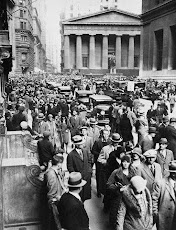
Business Week Reports, January 27, 2009, "Already 170,000 jobs have been lost in January. The U.S. economy lost 2.6 million jobs in 2008." The worst news, though, may be that some economists say in their most optimistic view the U.S. has only reached the halfway mark in terms of the layoffs expected for this recession. A growing number of economists also say that the U.S. economy is not just shedding jobs temporarily, but may be undergoing a painful restructuring process that will eliminate some types of jobs for good. "We are seeing very large layoffs—the kind you get when companies don't expect to be re-employing any time soon," says Peter Morici, a professor at the Robert H. Smith School of Business at the University of Maryland. "They [represent] structural, not cyclical, changes to the economy. We're looking at a permanently smaller economy with prolonged unemployment at an unacceptable level." "We are very early in the cycle," says Morici. "We are going to see the fury of the Old Testament for what we have done to the economy." Read the whole article at: http://www.businessweek.com/bwdaily/dnflash/content/jan2009/db20090126_735128.htm?chan=top+news_top+news+index+-+temp_top+storyTuesday, January 27, 2009
Employment Layoffs Widen in Economy, More Sectors Impacted
Business Week Reports, January 27, 2009, "Already 170,000 jobs have been lost in January. The U.S. economy lost 2.6 million jobs in 2008." The worst news, though, may be that some economists say in their most optimistic view the U.S. has only reached the halfway mark in terms of the layoffs expected for this recession. A growing number of economists also say that the U.S. economy is not just shedding jobs temporarily, but may be undergoing a painful restructuring process that will eliminate some types of jobs for good. "We are seeing very large layoffs—the kind you get when companies don't expect to be re-employing any time soon," says Peter Morici, a professor at the Robert H. Smith School of Business at the University of Maryland. "They [represent] structural, not cyclical, changes to the economy. We're looking at a permanently smaller economy with prolonged unemployment at an unacceptable level." "We are very early in the cycle," says Morici. "We are going to see the fury of the Old Testament for what we have done to the economy." Read the whole article at: http://www.businessweek.com/bwdaily/dnflash/content/jan2009/db20090126_735128.htm?chan=top+news_top+news+index+-+temp_top+storyMonday, January 26, 2009
Fears of Credit Crunch Crimewave Hit UK
"ministers were warned yesterday after figures showed increases in burglary, theft and knife robberies. Conservatives and Liberal Democrats said there was "clear evidence" the recession was leading to increases in offences, while Jacqui Smith, the Home Secretary, insisted the Government was working to prevent the downturn leading to rises in criminality. Last week The Independent revealed many police forces were reporting sharp increases in some offences as the recession started to bite in the final three months of 2008, with burglary and robbery doubling in some areas. Yesterday's Home Office figures, which cover July to September, gave the first official indications that the economic downturn has coincided with signs of rising crime."
Fears over credit crunch crime wave, http://www.thisissouthwales.co.uk/news/Fears-credit-crunch-crime-wave/article-637092-detail/article.html
Excerpts, "SOUTH Wales may not escape a "credit crunch crime wave", despite figures released yesterday which show crime has fallen. Nationally, rises in burglary and theft prompted the Tories and Liberal Democrats to issue a warning that crime would continue to rise as long as the economy was failing, despite there being a reported three per cent reduction in crime overall in the UK.
On Tuesday, the Chief Constable of South Wales, Barbara Wilding, said burglaries, robberies and domestic abuse cases were the most likely to rise."
Fears of credit crunch crimewave, By Ben Parsons, Crime Reporter . The Argus, 10:00pm Friday 23rd January 2009; http://www.theargus.co.uk/news/4072644.Fears_of_credit_crunch_crimewave/
Excerpts, "Desperate families are stealing food from shops as the recession drives people to crime. Frozen food, bread and meat are being snatched from the shelves, prompting fears a credit crunch crimewave is already hitting Sussex. At the end of 2008 robberies in the county were up nearly a quarter on the year before, with burglaries also on the rise. The figures have prompted calls for more police on the streets and a plan to deal with a rise in stealing as the economy worsens. The most shocking examples in recent weeks have come from Lewes, where police have seen a 40% rise in shoplifting compared with last year. Officers reported many of the culprits are simply people stealing food to feed their families.
Tuesday, January 13, 2009
Investors Business Daily - Crime Wave Coming...

From the Investors Business Daily we read the following editorial (partial)--
"Law And Order: It was the one issue left undebated during a campaign full of debates. But crime, along with the economy, may be one of the biggest issues this new administration faces. In fact, the two issues may be connected. The FBI is already blaming the bad economy for a rash of armed bank robberies around the country. And bandits, quiet for years, have become more brazen. In the Los Angeles area, which has seen a spike in robberies, they've pistol-whipped tellers. In North Carolina, Maryland and Kentucky, armed robbers have even kidnapped bank workers and their kids and forced the employees to help in heists. The FBI is also seeing a trend of entire ATMs being swiped. Solving bank robberies is what the FBI does best. But it's preoccupied with a politically motivated witch hunt against "predatory" bankers — not robbers — right now. That has to change. In another sign of the times, shoplifting is on the rise, with some major retailers reporting a record 20% surge in store theft."
Read the full article at http://www.investors.com/editorial/editorialcontent.asp?secid=1501&status=article&id=316653238215116
Monday, January 12, 2009
The Happy in New Year, was getting out of 2008
The Happy in New Year, was getting out of 2008 while still standing. Consider what we navigated in 2008 as we swam through the financial guantlet of floating ice.Early drop in stock market starting the first week of January, then successive bear market rallies with lower highs, and lower lows throughout the year;
Tuesday, December 30, 2008
Fears of Crime Wave Grow in Canada
From Toronto -- Agencies brace for crime wave
Experts say 2009 may mimic recession of 1990, when job loss drove people to desperate measures, Dec 27, 2008 04:30 AM, Robyn Doolittle STAFF REPORTER
"No one knew exactly how bad it was going to get, but economists warned of a difficult year ahead. It was December 1990. All predictions indicated a deepening recession and further job cuts. Worse still, a rapidly emerging crime wave was beginning to paralyze the city. Two weeks before Christmas, Toronto was hit by a record 26 robberies in one day – banks, cabs, stores, restaurants, pedestrians – many involving weapons. It was more than just a holiday blitz.
Police blamed the deteriorating economy and rising unemployment. Things only got worse in 1991, when Ontario experienced record high crime rates. It wasn't until the mid-1990s that the numbers began to taper off. Today, the GTA is one of the safest regions in Canada. The last decade has seen dramatic – and consistent – decreases in almost every criminal classification.
But now some experts are worrying that history may soon repeat itself."
From Alberta -- Canadians prep for economic induced crime wave.
By TAMAS VIRAG, SUN MEDIA, January 28, 2008.
"Cops and criminologists are warning that a serious downturn of Ontario's economy could mean more organized crime for Alberta. ""People go where there's money. If there's money here and it's disposable, someone's going to be looking for a piece of it," Sgt. Peter Ratcliff of the Edmonton Police Association said yesterday. "What that might look like, I don't really know." Criminologist Bill Pitt, however, has an idea of what that future may look like. And it's not pretty.
"You're going to see more narcotics on the street, pushed at lower prices. You're going to see more prostitution on the street, pushed at lower prices," he said, adding that the fallout from an increased number of gangs competing for one of the last pieces of prime Canadian turf might reach rarely seen proportions. "I think there's going to be issues between and among organized crime groups that are going to be fought out in the street, as they were in the recession in the '30s in Chicago ... fighting for dominance," he said, adding that all-out gang warfare - such as the one seen a decade ago in Quebec between two competing biker gangs - is not out of the question.
Part of the problem, he continued, is that police forces in Alberta have been facing west, working hard to keep out bad influences from Vancouver, but have largely ignored threats from the East.
"It's our back door and it's wide open ... I think we're going to see more movement from the East, we're going to see more intrusion from major organized crime," he said. "We're playing catch-up to them, and they're on the way."
Sunday, December 28, 2008
Australia, UK, and US prepare for financial crises led Crime Wave
Australia's Victorian police warning as hard times spur crime wave
The Australian reported on 12/27/08, "POLICE are bracing for a new wave of economic crimes driven by the financial crisis and rising unemployment, such as theft and burglary, after studying crime patterns from the previous downturn. Senior officers have drawn on crime statistics from the 1990 recession, when so-called property crime jumped sharply, to pinpoint the types of offences expected to rise as the financial crisis deepens."
The Australian further reported, "By tracking crimes over the past six months, police have found offences such as theft of valuables from motor vehicles, house burglaries, street robberies, handbag and wallet theft, shoplifting and other types of theft have begun to rise, as they did in 1990. Victoria's Deputy Commissioner of Police Kieran Walshe told The Weekend Australian: "We are starting to see crimes against property beginning to trend upwards. We have also seen an increase in petrol theft and those sorts of things. "Those are the kind of things potentially that are going to increase if you have a slowing economy. Particularly as unemployment starts to rise, that's going to cause people in some circumstances to seek other means of getting money."
With the article, the Australian reports, “Crime figures show that, in 1990-91, there was a sharp jump in property crime in Victoria compared with the previous year. Theft rose 13.6 per cent, robbery 12.3 per cent and burglary 8.1 per cent. The rates of those crimes began falling again as the economy began to pick up in following years. Victoria Police this month arrested a gang that had carried out eight ram-raids on retail outlets in Melbourne's northern and western suburbs in recent months, resulting in $700,000 in stolen and damaged property. About $150,000 in stolen goods was recovered. Mr Walshe said research on previous economically driven crime sprees would help develop preventative strategies, such as increasing police patrols in certain areas or encouraging the community to be more vigilant. “
UK public officials prepare for crime wave
Martin Gill, Ph.D., the well-respected criminologist cross-over Academic/Practioner, wrote the following this past week in his monthly Perpetuity newsletter to industry colleagues -- "Will crime rates rise with the failing economy? The Home Secretary, Jacqui Smith, certainly thinks so warning that violent crime could grow by nearly a fifth based on increases seen during the 1991-2 recession. But the academic evidence suggests that won't be the only crime type that's set to rise; fraud, forgery, burglary, robbery, theft, and arson have all been linked to recession and unemployment So what does this mean for you? It's clear that at a time when budgets are being reduced cutting back on security is not an easy option; with crime rates set to rise cutting back on security could result in rising costs of crime. Instead it's a good time to review your existing processes to identify any opportunities to improve efficiency and work smarter to cut costs, achieving greater value for money. "
US law enforcement prepares for crime wave, not uniformly, but in noticeable hotspots
Within the US, police chiefs are preparing for a coming crime wave of sorts, from the experienced professionals such as Chief Bratton of LAPD, to others that are dealing with increasing crime rates in south Florida, the Midwest and other locations impacted by economic misery harder than most.
Monday, December 15, 2008
Unemployment continues to rise; business capital still contracting; nimbleness key
On business capital availability. Despite the optimism voiced by market pundits that report that we are bottoming, or near a bottom, there is still no bottom in site. Businesses are dealing with a sharp drop off in demand since 9/15/08. Some businesses will not recover through Q4, and are expected to file bankruptcy in 2009. The only certainty is that the future is cloudy, capital is still tight, and for-profit businesses are seeking to jettison costs to get to cash-flow positive, or bust. On this note, I have observed recently that several companies operating on business models based on debt-based growth are now dead. Cool technologies are locked in bankruptcy, proving once again that supply does not create demand, and oversupply for goods that don't sell can be costly. The market sentiment towards debt has now come full circle. Vultures look ready to pick the bones of bankrupt companies for pennies on the dollar.
Nimbleness. In these times, it pays to be quick to respond, proactive in cutting costs, focusing spending on needs and not wants. There is opportunity, but you must be willing to get out of your comfort zone and seize it. The age of debt-based finance business strategies is over for a season, perhaps longer. Promising companies that appeared to have great technologies and rapid growth that were funded on debt are now falling fast. Calls from business owners looking to dump their cash-guzzling business units are increasing and there is little capital out there for continuing operations beyond factoring receivables, that assumes companies are indeed making money. Just like the Kenny Rogers line, you need to know when to hold them, and know when to fold them. Some business plans are dead now, and it takes a brave heart to move nimbly and thoughtfully to where the cheese has been moved.
Future opportunities. I mentioned in an earlier post that my own security consulting business experienced a 'lock-up' or freezing of pipeline of sorts since 9/15/08, as a sizable block of contract suspensions and stop-work orders were focused on future construction projects where the monies for job completion were uncertain. At the same time as the construction related pipeline was freezing, I noticed a small bounce in restructuring related security consulting opportunities, which bounce has now turned into a sizable bounce. Being nimble means being willing to move on from the old plan when it is not working. What is working today is focusing businesses on reducing operating costs through restructuring and replacing routine manned operations by automated processes where possible. Remote monitored and delivered business process business opportunities are huge. While the economy is clearly down, buildings, physical assets, and other operations frequently remain with tighter budgets -- and having a labor saving technology to automate routine processes to save time and money are the new rage.