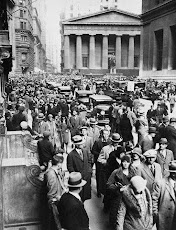
Friday, November 21, 2008

Contrarian View - NPR broadcasts story that Bad Economies do not lead to crime waves

Mark Twain is credited with saying, there are liars, damn liars, and statisticians. That is the problem with examining crime data from the Great Depression era. Mainstream criminologists examine sterile statistical data and make general assumptions about human behavior and crime based on this data. However, frequently, there are nuisances in the data that render the conclusions of the data invalid. Consider the category of crime called "floating bodies," this is the way that Ecorse Police Department of Michigan recorded dead human bodies pulled from the river that float down from Detroit and parts north in the early 1990s. This mis-labeling had the effect of hiding the crime data as there is no FBI Uniform Crime Report (UCR) category called floating bodies. Hmmmm.

Well in a more heinous manner, crime data being analyzed from the 1930s have been likewise scrubbed of real meaning leaving the picture that crime actually went down during the Great Depression -- leading some to falsely assume that we should expect no crime wave from the economic downturn. Nothing could be further from the truth -- crime was horrible, and it took specific large actions to combat crime before it finally receded. This is not considered in the article that appeared on National Public Radio titled,

Experts: Bad Economies Don't Cause Crime Waves
http://www.npr.org/templates/story/story.php?storyId=97234406#commentBlock
Article conclusion: “The Depression years had very little crime.” “With the economy's current troubles, many people assume a crime wave is just around the corner. But criminologists say that's just an American myth. Just look at the 1920s, says David Kennedy, director of the Center for Crime Prevention at John Jay College of Criminal Studies. "It was a period of booming economic prosperity, the roaring '20s, and very high crime," he says. The 1950s and '60s were the same. The economy was great, but crime rates rose every single year.

Nothing could be farther from the truth. Not only was there a huge crime wave in starting in the 1920s and extending in greater flagrancy in the 1930s with the onset of the Great Depression, but the crime was so severe that the Federal Government created a strategic crime control plan of sweeping broadness that it rivals the Paulsen Financial Plan today. Consider that the US government went to great strides to combat crime in the 1930s that included the creation of the FBI, elimination of Prohibition stripping organized crime of illegal gains from liquor sales, and most formidably, the era saw the creation of the Civilian Conservation Corps to incapacitate serious habitual offenders and provide crime demand reduction programming for the young male unemployed population living in the cities, and they were sent to rural work bootcamps.

There is a strong linkage between negative economic shocks, economic hardship, unemployment, and loss of purchasing power and crime -- and the relationship is stronger with more significant economic shocks. The crime wave that was prevalent during the in the 1920s and early 1930s was significant and brutal, and was only brought under control after the implementation of the FBI and the extraction of serious habitual offenders from the general population, along with a large cohort of young unemployed men at greatest risk for crime. Modern researchers fail to understand the significant crime environment of the 1930s and falsely claim that statistical reports of reduced crime during the depression occurred as a natural result. Rather crime went down during the Depression when over 500,000 unemployed young men of greatest risk for crime involvement were taken out of the cities and placed into 2300+ work camps managed by the CCC. The statistics show that in 1934, young men between the ages of 18-24 comprised only 6% of the population, but accounted for 51% of arrests for auto theft, robbery, burglary, rape, and assault; one-third of larceny arrest, and two of ten homicide arrests. It was necessary for the US Government to proactively remove a significant portion of the unemployed population at greatest risk of crime involvement, and they placed them in work camps in rural areas managed by the Civilian Conservation Corps (CCC). This is the primary reason that crime reduced -- there were fewer likely offenders. The impact of a huge targeted diversion program, taking the unemployed males of greatest risk out of the city and sending them to camps in the rurals had a huge impact by reducing likely offenders.

On background, the CCC was created by President Franklin Roosevelt on March 23, 1933, just three weeks after his inauguration. The CCC would operate as many as 2,650 rural work camps with up to 500,000 young high-risk unemployed males engaged in these camps. The “enrollees” were removed from the general population and were geographically isolated so that they could not be a risk to the populations remaining in the cities. The camps operated with military discipline and supervision of the US Army. Free time was provided for enrollees but there was no access or transportation to leave the work areas. These camps provided the geographical containment of a prison through their isolation.

These and other notes are contained in my forthcoming book, Severin Sorensen, CPP, Economic Misery and Crime Waves: The future history of the second coming of the Great Depression and the crime wave that followed, and what to do about it.

# # #

Sorensen, Severin. "Contrarian View - NPR broadcasts story that Bad Economies do not lead to crime waves." Weblog post. Economic Misery and Crime Waves. 21 Nov. 2008. .

Tuesday, November 18, 2008

Crime On Rise In Quiet Broward Neighborhood

There is a theme growing with crecendo on this blog and that is crime is growing, not receding as a consequence of economic misery expressed in terms of economic hardship, unemployment, and loss of purchasing power (sometimes referred to as inflation, but could also describe reduced equity in home values).


Crime is occuring in neighborhoods that were formerly sleepy, where nobody would think you would have crime. Consider this story posted from Broward County Florida. Within the last few months, crime has been on the rise in this normally sleepy town.

In an article titled Crime On Rise in Quiet Broward Neighborhood we read these statements --


We usually don't lock our stuff but now we do. It's very sad," said neighbor Michelle Duke.

Locals residents report a string of boat thefts.

"Three this week is what I heard," said one neighbor.

They're also reporting car break-ins.

"My husband walked out at about 5:30 this morning and there was just glass all over the driveway," said another.

Jon Jenkins has experienced a little of both.

"My house, five times this year. I've had motorcycles stolen, numerous tools and now the boat," he told Local 10's Sasha Andrade.

Police said thieves are driving around with trucks and simply hooking up any boat and trailer in sight.


"We're putting a wall up and gates and surveillance cameras. That’s what it’s come to," Duke said.

.The Sheriff’s Office said anyone with a boat should lock down the trailer, or run a steel bar through its rims. They said you should do whatever you can to make your boat less appealing to thieves


Monday, November 17, 2008

Past as Prologue: Pirates Sieze Oil Tanker Carrying Two Million Barrels of Oil

During the Great Depression, criminals targeted the Osage Indian tribe in Oklahoma to steal their land rights to their oil fields. Through trickery, extortion, and murder, criminals swindled oil and property rights away from land granted members of the Osage Tribe. The extent and depravity of lawlessness and slaughter targeted on the tribal members on US soil was one of the pivotal milestones that led to the creation of the FBI in the 1930s.

Economic hardship of global proportions has struck again, and criminals have become more brazen. This target is again oil and other commodities in transport. The technology used by the modern Pirates enables them to out maneuver law enforcement. Consider the Somali Pirates caper in progress. Pirates operating off the coast of Somalia seized a large oil tanker, approximately three times the size of a US Aircraft Carrier. The Oil tanker was seized approximately 450 miles off shore and was carrying 3 million barrels of oil.

Somali pirates also hijacked a 26,000-ton Iranian cargo carrier on Tuesday. A US Navy officer operating in the theatre of the piracy has commented, "It is suspected that these Pirate gangs have become more sophisticated, operating large "mother ships," often former Russian trawlers, which follow their targeted ship with GPS devices. When they are close enough, they offload smaller dinghies or speedboats that move in for the capture. "

"They just come up to the stern, throw up their hook and ladder, and once you are on board, the ship is yours, because no one is going to mess with a man with an RPG [rocket propelled grenade launcher]," says Richard Cornwell, a senior researcher at the Institute for Strategic Studies in Tshwane, as Pretoria is now called. "Once [they're on board], it's over in 10 to 15 minutes. Unless you have a warship in the immediate area, and crucially, with a helicopter, you've got no chance of stopping them."

The great take away is that criminals are becoming more brazen, they are using technology to their great advantage. And through overwhelming incidents perpetrated by many, they operate with impunity.

Whether off shore on within our borders, brazen crime is on the rise.

# # #

Read two articles on this incident for greater detail.

http://edition.cnn.com/2008/WORLD/africa/11/17/kenya.tanker.pirates/?imw=Y&iref=mpstoryemail

http://www.csmonitor.com/2008/1119/p01s03-woaf.html

Economic Misery Deepens - 50,000 Citibank Employees to Lose Jobs

Ronald Reagan is credited with saying, "Recession is when a neighbor loses his job. Depression is when you lose yours." Sadly, it is depression time for nearly 73K Citibank employees who have lost their jobs within the past year (23k prior to today, and another 50k announced this morning). I do not think the general public knows how bad it truly is out there. Sure they hear the news, but just exactly how the news relates to them is often a mystery, until it is too late for them.

If you have a job, keep it, do everything you can do to be a model employee to make the cuts that will be coming. If you are looking for a new job, do not let go of your old job until you have a new one firmly in place. If you have lost your job, consider where the new economy is headed and dont be afraid to move your ground. In looking at my own family history, in the Great Depression, my grandfather moved from the Detroit area to California where there was more opportunity -- where are the opportunity areas today? Put your thinking caps on and get there sooner, wherever 'there' is.

From Bloomberg news we read this morning -- http://www.bloomberg.com/apps/news?pid=20601103&sid=a13FLUOxOAyw&refer=us

"Nov. 17 (Bloomberg) -- Citigroup Inc., the U.S. bank with the most employees, plans to eliminate more than 50,000 jobs and cut expenses by 20 percent from their peak as the global economy contracts. Chief Executive Officer Vikram Pandit intends to reduce headcount by about 14 percent to 300,000 in the ``near term,'' according to a presentation on the firm's Web site today. Pandit has already cut 23,000 jobs, leaving the New York-based bank with 352,000 employees as of Sept. 30. Citigroup slumped 19 percent in New York trading last week and is down 68 percent this year, after four straight quarterly losses totaling $20 billion. The fourth-biggest U.S. bank by market value will probably post a loss of about $187 million for the fourth quarter, analysts surveyed by Bloomberg estimated. "

In terms of others within the banking sector, Bloomberg news reported the following,
"Banks and brokerages worldwide have announced more than 200,000 job cuts since the subprime mortgage market's collapse last year sparked a credit crisis. Goldman Sachs Group Inc., which converted last month from the biggest U.S. securities firm into a commercial bank, began earlier this month telling about 3,200 employees, or 10 percent of its workforce, they were out of a job, according to a person familiar with the decision. Citigroup, Goldman Sachs and rivals such as Merrill Lynch & Co. have been reducing staff as the revenue outlook dims for banks and securities firms. Most major global stock indexes have dropped more than 25 percent this year, with the Standard & Poor's 500 Index down 40 percent. The International Monetary Fund's World Economic Outlook forecast last month that global growth will weaken to 3 percent in 2009, from 3.9 percent this year and 5 percent in 2007. "

Saturday, November 15, 2008

Intelligence Experts see Security Risks in Global Economic Downturn

On the front page of the Washington Post this morning (11/15/08) is an article titled, "Experts See Security Risks in Downturn: Global Financial Crisis May Fuel Instability and Weaken U.S. Defenses." The article warns that two forces are colliding with potential harmful effects to US security and global safety: (1) economic downturns in economies globally are causing increased economic hardship and political instability (in terms of food price inflation, rising unemployment), giving rise to vulnerability of insurrection and influence of extremist groups like Al-Qaeda, or new political alliances not in line or mind with US interests as those hit hardest in third world countries seek money (and by reference new political economic relationships) with those with funds, with China being the most likely financier. (2) the second trend they see is governments globally, but particularly in the US preparing to downsize their expenses in military, intelligence, and criminal justice due to budgetary concerns, or new Obama presidential administration interests, just at a time when crime and terrorism opportunity is rising.

Key highlights of the article by Joby Warrick, Washington Post Staff Writer Saturday, November 15, 2008; Page A01, include the following, " Intelligence officials are warning that the deepening global financial crisis could weaken fragile governments in the world's most dangerous areas and undermine the ability of the United States and its allies to respond to a new wave of security threats. U.S. government officials and private analysts say the economic turmoil has heightened the short-term risk of a terrorist attack, as radical groups probe for weakening border protections and new gaps in defenses. A protracted financial crisis could threaten the survival of friendly regimes from Pakistan to the Middle East while forcing Western nations to cut spending on defense, intelligence and foreign aid, the sources said. " Read the entire article at http://www.washingtonpost.com/wp-dyn/content/article/2008/11/14/AR2008111403864.html?hpid=topnews

The article author has focused their narrative on terrorism, but what is much more likely is insurrection, economic misery, and increased crime occurring in these locations that can create environments where terrorists can thrive with impunity. The world is into a deep global recession, and if unabated the history books will read the second coming of the Great Depression. In third world countries particularly, many people are hungry, unemployed, and feeling miserable and the World Bank has correctly assessed the risk.

Joby Warrick writes, "As bad as economic conditions are in the United States and Europe, where outright recessions are expected next year, they are worse in developing countries such as Pakistan, a state that was already struggling with violent insurgencies and widespread poverty. Some analysts warn that a prolonged economic crisis could trigger a period of widespread unrest that could strengthen the hand of extremists and threaten Pakistan's democratically elected government -- with potentially grave consequences for the region and perhaps the planet. Pakistanis were hit by soaring food and energy prices earlier in the year, and the country's financial problems have multiplied since late summer. Islamabad's currency reserves have nearly evaporated, forcing the new government to seek new foreign loans or risk defaulting on the country's debt. The national currency, the rupee, has been devalued, and inflation is squeezing Pakistan's poor and middle class alike. "

As the world leaders from the G-20 meet in Washington DC this weekend, it is becoming increasingly apparent that a deep freeze has hit the global economy, and one of the baneful consequences of the downturn is increased economic misery, crime opportunity, and terrorism threats. The world has changed, how much we do not yet know, but when the dust settles it will look like a different place.

To conclude this post, normally, at this time of year we in America prepare for Thanksgiving and thereafter a Christmas holiday season where children hope for gifts under the Christmas tree and candy in their stockings. This year however, I think I will opt for “coal” in my stocking as it looks to be a long cold winter.

Friday, November 14, 2008

UK economic woes turning up in cocaine seizure spike and feared crime wave

When one loses their job do to lay-offs, they don't necessarily lose their bad habits. For those who are addicted to drugs (whether illegal or prescriptive), their addictions when experiencing economic hardship can increase their risk of going to criminal lengths to support their baneful habits.

Reported today in the UK was an article with the headline, "Credit crunch cocaine crimewave predicted," that appeared Friday, November 14, 2008. The article goes on to report, "Police fear a crimewave could be looming 'on the horizon' as cocaine seizures across South Devon continue to rise at an alarming rate." The article reports that police are seeing a 50 per cent jump in seizures of cocaine. Figures just released reveal that seizures of cocaine in Torbay, South Hams and Teignbridge last year totaled 100 against the tally of 75 the previous. Already this year, from April, the number is up to 51 and rising steadily. DC Bradley said: "The number of significant seizures is also on the increase. "Many confiscations involve small amounts of cocaine for personal use, but there have been recent seizures on the M5 into the county which have seen amounts weighing in at as much as four kilos with a street value of £200,000."
A few notable quotes from police included, "When they lose their job and can't pay the mortgage and lose their home they still want their drug." "They become desperate and become involved in crime and steal. "Cocaine is now more prevalent. That's reflected in the seizures. It's a cause for some concern."
Read the full article at http://www.thisissouthdevon.co.uk/news/Credit-crunch-cocaine-crimewave-predicted/article-474726-detail/article.html

Hard times hit Mexican illegal drug trade, competition among rival gangs leads to violence as homicides spike up

In down turned economic times, competition for scarce resources and territory becomes intensified. This was true during the Great Depression when "Depression Desperadoes" gangs and thugs began crowding each other out when the economy went into a tailspin, and fewer dollars were available from their criminal enterprises. There is another similarity to the Great Depression era -- the old familiarity and corruption that some police and criminals seemed to enjoy together came to an about face and street war with the creation of the FBI and the battle royale that ensued. This phenomenon appears to be repeating itself in our era south of the US border.

Consider what is happening south of the US border in Mexico. Mexico has been hit by a brutal crime wave as rival drug gangs step up attacks against each other and the police. More than 4,000 people have died this year in violence connected to criminal gangs in Mexico. The intensity of violence rivals the violence levied by the Columbian cartels bringing full the mean streets of brutality, violence, and fear. The gangs are using typical intimidation tactics used in trafficking that involve stark displays of violence and murder. This past week, a Mexican newspaper reporter working in Juarez along the U.S. border was shot by armed men that killed the reporter on his way to work Thursday. From the press report, "A recent series of drug-related violence has left at least seven people dead in the northern border city. Police said Monday that a burned and mutilated body was dumped in front of a police station. Authorities say police later found two men and two women shot to death outside a medical clinic. The Associated Press reported that a woman's body was found in a trash bag, while a bystander was killed in a car crash caused by a police chase. On Monday, Mexican President Felipe Calderon named a former federal lawmaker, Fernando Gomez Mont, to replace Interior Minister Juan Camilo Mourino, who died in a plane crash last week in Mexico City.Mourino was a central figure in Mr. Calderon's government and helped lead a campaign against mounting violence by drug cartels. " Read the original article -- http://www.voanews.com/english/2008-11-13-voa45.cfm

Historically, thinking of lessons learned from the last great crime wave that broiled during the Great Depression, only when the federal government rationalized the illegal markets and stripped organized crime from their prohibition-led intoxicant sales did the situation turn around. Additionally, and not to be ignored, it took updated police methods along with new technologies to rival those being used by the criminal gangs to turn around the problem then in order to overcome the not insignificant local corruption problems of the era.