Saturday, April 18, 2009

UN Council Meets on Global Crime Wave

UN crime control authorities report global crime wave.  From April 16-24, 2009, in Vienna,  The United Nations Commission on Crime Prevention and Criminal Justice (CCPCJ) will convene its 18th session; multiple topics are planned, but the theme running through the topics is discussion of the current international crime situation labled "a global crime wave" by Antonio Maria Costa, Executive Director of the United Nations Office on Drugs and Crime (UNODC) .

In his openning remarks, Costa said "crime has gone global," representing proliferation of organized crime.  Costa warned that "Organized crime poses a threat to the security of cities, states, and even entire regions."   One news report from the meeting quoted Costa as saying "the drug cartels spread violence in Central America, Mexico and the Caribbean, while the collusion between insurgents and criminal groups threatens the stability of West Asia. There were also such criminal activities as the smuggling of weapons, plundering of resources, kidnapping as well as human trafficking in many parts of the world."  Gang violence in some cities remains a problem.  These traditional crimes are increasing, however new technology crimes such as cyber-crime and economic fraud are threatening many nations.  Costa predicted that the economic crisis would deteriorate this current situation into a global crime wave.

The meeting agenda for appears at this link. http://daccessdds.un.org/doc/UNDOC/GEN/V09/806/34/PDF/V0980634.pdf?OpenElement


Tuesday, April 7, 2009

Current Events - Musings on Crime Waves Brewing

Evidences of increasing economic misery and climate for crime waves.

Americans Feel 15.6% Unemployment as Underemployment Surges 

Bloomberg.com reported that workers are feeling real pain from the recession that began in December 2007; they’re not represented in the U-3, 8.5 percent unemployment rate the Labor Department reported last week. Underreported unemployed workers are part of a broader group called U-6 that includes those who want a job but have stopped looking for work and those who want full-time positions but have to settle for part-time employment.  A measure of underemployment that counts those people has almost doubled over the past two years, to 15.6 percent, providing a more complete gauge of the labor market’s deterioration. Along with an historic drop in the percentage of the population who are working, and record numbers of long-term unemployed, the figures point to a permanent shift in employment patterns, said former U.S. Labor Secretary Robert Reich.


Kidnappings -- "Bossnappings" -- French Factory Workers hold Caterpillar Executives Hostage -- From the Herald Sun (Au), Employees at Caterpillar's factory in the southeastern city of Grenoble barricaded bosses inside an office yesterday after talks on a compensation deal for 733 workers facing redundancy broke down. Earlier, French President Nicolas Sarkozy said he would meet the workers to discuss their demands. "Caterpillar is a firm that makes earthmoving equipment and which works mainly in the United States. The collapse in demand has been 80 per cent," Mr Sarkozy said, in an interview with Europe 1. "I will save the site. I will meet the union leaders since, if I understand right, they called for my help and I understand this. I won't let them down." It was not immediately clear what Mr Sarkozy's promise amounted to: The "site" as such is not under threat, but 733 of the firm's 2800 jobs at two plants in Grenoble are due to be cut.  Nevertheless, Mr Sarkozy's failure to criticise the workers for denying the bosses their freedom of movement could give encouragement to the organisers of increasingly militant protests across the country. The action was the latest in a spate of so-called "bossnappings" in France as anger mounts over the global economic crisis, and the President and his ministers have taken a careful approach to the protests. More on this topic; http://news.google.com/news?pz=1&ned=us&hl=en&q=bossnappings

Fraud -- scams surrounding foreclosure assistance -- Scams target homeowners seeking foreclosure rescue, MiamiHerald.com, South Florida is teeming with companies promising to help modify loans for borrowers facing foreclosure. The article states, "In loan modification scams, companies typically charge homeowners thousands of dollars in upfront fees to modify a loan, then make off with the money without providing aid. In other schemes, so-called investors convince borrowers to transfer title of their homes to themselves or a third party only to evict them later and sell the property. To lure customers, scammers often use company names that resemble legitimate nonprofits or government agencies consumers have heard about in television and radio advertisements, the Federal Trade Commission said."  More on this topic; http://news.google.com/news?pz=1&ned=us&hl=en&q=home+lending+refinance+fraud


"Amid Recession, FBI Makes New Push on Financial Crimes", U.S. News & World Report (04/01/09) ; Kingsbury, Alex

From the ASIS Daily Feed - "As financial crimes such as Bernie Madoff's massive Ponzi scheme continue to grab headlines, the FBI is increasingly shifting its focus away from terrorism and towards fighting white-collar crime. Over the past five weeks, the FBI has opened more than 200 mortgage-fraud cases and 36 corporate-fraud investigations. Both numbers are expected to continue to grow rapidly in the near future, top FBI officials say. In another sign that white-collar crime has become a bigger priority at the FBI, the number of agents dealing with fraud has risen from 75 in October to more than 250 now. But despite the shift in focus at the FBI, justice for those involved in white-collar crimes may be slow in coming, since the crimes generate large amounts of paper and electronic records and can take years to investigate and prosecute." More on this topic; http://news.google.com/news?pz=1&ned=us&hl=en&q=financial+crimes+investigation

"Insider Fraud Swells as Banks Suffer".
Bank Technology News (04/09) ; Sausner, Rebecca

Another from the ASIS Daily Feed - Fraud is occurring more frequently as both crooks and employees seek ways to capitalize on vulnerabilities amidst economic uncertainty. Many risk teams are now trying to contain fraud at a moment when they are especially vulnerable. Bank of America's risk team received its wake-up call in March when one of its bankers was found participating in "rogue trading" activities that cost the company $120 million, while Actimize, a third-party risk mitigation vendor, discovered at one firm 19 employees who had pilfered money shortly before the fraud detection system was activated. These incidents affect corporate bottom lines, so security vendors are not surprised at the business they are getting even as many industries slow down. In fact, most major companies have increased their spending to purchase more comprehensive detection platforms, says Jaidev Iyer, a managing director with the Global Association of Risk Professionals.  More on this story: Insider fraud spikes as cyber espionage spreads, http://www.computerweekly.com/blogs/editors-blog/2009/04/insider-fraud-spikes-as-cyber.html


Friday, March 20, 2009

Unemployment climbs, no signs of leveling off yet

Unemployment continues to rise.  From the Bureau of Labor Statistics, comes this news, "In February [2009], employers took 2,769 mass layoff actions involving 295,477 workers. Mass layoff events increased by 542 from January, and initial claims increased by 57,575. Layoff events for all industries and for the manufacturing sector rose to their highest levels on record. Thirty states reached program highs in average weekly initial claims."

Bloomberg News reported that "the national jobless rate rose to 8.1 last month, the highest in more than a quarter century, and the economy has lost 4.4 million jobs since the recession began in December 2007."  Chairman Bernake said on 3/10/09, that it was “certainly within the realm of possibility” that average unemployment nationwide could rise above 10 percent and stay there for a period of time, reported, Bloomberg.

Source: Bloomberg.com

The Index measures the US unemployment rate on a monthly basis on an seasonally adjusted level. The unemployment rate represents the number unemployed persons as a percent of the labor force. Each month approximately 60,000 sample households are interviewed (a portion is done via telephone) during the week that includes the 12th of the month. Not Seasonally adjusted.

Regional unemployment is climbing in certain areas that include California.  Bloomberg reported today, "California’s jobless rate surged in February to the highest level since 1983 while unemployment in Oregon and Nevada climbed above 10 percent for the first time in more than two decades. Unemployment in California rose to 10.5 percent from 10.1 percent in January, its Employment Development Department reported today in Sacramento. Neighboring Oregon’s jobless rate rose a full percentage point to 10.8 percent, and Nevada’s increased to 10.1 percent."

Thursday, March 19, 2009

Economic misery in Argentina leads to Crime Wave, 10,000 Protest March, another 100,000 people support the march

It has started.  Mark the date.  March 19, 2009 marked the public acknowledgement of an international crime wave that started gradually, and now suddenly in global pockets of economic misery.  

Today, crime is being experienced and reported with increasing frequency throughout the globe.  A recent survey of US major city police chiefs cited increased concern for crime and crime opportunity, just at a time when budgets are being reduced and crime opportunity is increasing.  Within the posts of this blog the author has reported increasing crime evidences from reported observations of localized crime waves in Argentina, Australia, Russia, Israel, Mexico, off-the-Somalia coast, UK, and the USA, and most ferociously in the developing countries.   Public officials will urge caution in declaring any definitive time or existance of a crime wave, however it is being felt and experienced by many around the globe.

What then is a crime wave? The Oxford Pocket Dictionary of Current English describes a crime wave as: Crime wave, • noun, a sudden increase in the number of crimes committed in a country or area.  Mark Fishman (1978) had a more meaningful definition -- “When we speak of a crime wave, we are talking about a kind of social awareness of crime, crime brought to public attention.”[i]  This  attenion may surface as a result of a catastrophic criminal event such as a particularly violent crime or spree of crimes, repeated hashing or rehashing of crime data, a particular news story of crime news or events, or some other shady calculation or notion brought to public attention.  The data may show a peak to trough pattern of crime, but public perceptions and fear of crime is a greater barometer of crime waves in terms of public thinking."

Graciela Lopez takes part in the march on Wednesday. Her 16-year-old son was killed by a drunk driver in 2007.
Graciela Lopez takes part in the march on Wednesday. Her 16-year-old son was killed by a drunk driver in 2007. (CNN Photo)

Reported this morning on CNN was an alarming story of public marches, exceeding 10,000 participants, marching in Argentina against a crime wave felt by the public.  Brian Brynes, CNN reporter, wrote, "BUENOS AIRES, Argentina (CNN) -- An estimated 10,000 Argentines marched on the historic Plaza de Mayo in the capital, Buenos Aires, on Wednesday to demand more anti-crime measures, reflecting a top priority among Argentines, according to recent polls. There were other anti-crime marches throughout Argentina on Wednesday night, as well. At least three police officers have been killed in Buenos Aires in recent weeks, and other high-profile crimes have grabbed the nation's attention. An employee of Argentina's most famous TV talk-show host, Susana Gimenez, was killed last month. That prompted Gimenez to call for the return of the death penalty. The death penalty was outlawed in Argentina in 1984, a year after the country's military ended its seven-year dictatorship, during which some 30,000 people were killed." Read the entire article on CNN.   See all stories on this topic 

The CNN article goes on to report that "Organizers used the Internet to mobilize people, setting up a Web page asking Congress to declare a national security emergency, and creating a Facebook page for the march. More than 106,000 people signed up as "friends." Those gathered in the Plaza de Mayo -- many carrying photos of their dead loved ones -- asked their leaders to act against rising crime." The internet will bring the immediacy of messages to many people exponentially quicker than the great depression when there was no email, no fax, no CNN.

It is time for the UN to call together the world's leaders, economists, criminologists, sociologists, and planners and prepare now for what shall surely be a scourge for the unprepared.

Preparation has its own Hawthorne effect, when you prepare, you change the outcome.  Let's not wait for the social science empiricists to measure definitively that we are experiencing a crime wave (such as the wait economists make in declaring a recession waiting for 2-quarters to occur 'while Britian burns') before we address the increasing negative consequences of a crime wave, that is exacerbated by the economic condition.  

When the patient is in the emergency operating room, it is not the time to suggest -- shall we give him placebo (a fake defibulizer) or the procedure we expect to most likely save the patient's life?  Much is known about crime already, especially about what works, and what does not work, and we do not have the luxury of time to conduct new double blind studies of interventions in the brewing sea-storm where some people get real aid and others get placebo.  In the words of Emerson, if you see that somebody has no shoes, you know the appropriate gift is shoes, and not some other form of aid.  

We are human beings, we are not rats or mice, and in our dire economic condition we must experiment on the run as we are facing a rapidly brewing cocktail of economic misery that will exacerbate crime conditions and crime opportunity itself.  We need to combat the conditions of crime opportunity with tactics that meet crime opportunity whereever, whenever, using manuver warfare style mobility.  

If we are prepared, there is no need to fear.

It is time for action.  We need local, regional, national, and international crime control strategies that are equal to the emerging challenges of our age.  We are experiencing a 100-year event, and our institutions were designed to handle the 20-year cycle events; we are unprepared.  It is time to get moving to make preparations for crime control and social controls to keep the majority of population from becoming civil disobedient in the face of economic challenges, as eating food becomes prima facie more important than the fact that the apples I am eating are on my neighbors property.  The rationalization for crime starts small, and if not abated, may increase and some may not return to their law-abiding ways.

There can be nothing more important on the world agenda than getting the economy back on the train tracks again, creating sustainable jobs, bolstering economic growth, and combating economic misery that may lead to increased crime if not abated.  All other talk of combatting global warming, solving all other manner of worlds problems must be secondary, for if the driver of the economic engine dies, there will be no resources for all other items.


[i] Mark Fishman, “Crime Waves as Ideology,” Social Problems, Vol 25, no.5, June 1978.

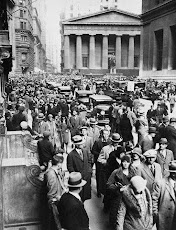
Why did crime decrease from 1934 onwards during the Great Depression?


There is a great myth held by criminal justice scholars supported by reported criminal justice statistics that crime went down during the Great Depression. The data clearly show that the crime wave of the Great Depression peaked in 1933, and went down thereafter in 1934 and the succeeding years until the end of the Depression.

So you have to ask yourself this question – did crime truly go down during the Great Depression, or was something else going on? Why was there such a sharp drop in crime in 1934 and thereafter? What was going on?

In a new book to be released in April 2009, Economic Misery and Crime Waves: the future history of the second great depression and the crime wave that followed, and what to do about it, this author suggests that reported crime during the Great Depression indeed went down from 1934 onwards, but not because there was necessarily less crime, but rather that the nature of crime statistics collection, reporting, and laws changed; furthermore, the emphasis was switched to going after the serious habitual offender (or SHOs), de-emphasis on minor crimes not arresting for minor property destruction, rail car break-ins, trespass, food thefts; and not unimportanly, a the creation of a huge crime demand reduction programs impacting those at greatest risk for crime opportunity -- young, unemployed males from the inner cities. These facts are largely ignored by criminal justice academicians that take the reported data at face value.

From an empirical standpoint, the dramatic reduction in crime figures post-1934 during the later half of the Great Depression can be explained by any one or combination of the following measures that have nothing to do with the real level of crime:
(1) decriminalizing crimes that were formerly illegal, as in repealing Prohibition and the attendant crimes that accompanied bootlegging and rum-running operations would have the natural effect of reducing the number of reported crimes, without changing the behavior of organized crime or cause them to turn from their vice practices; with the change in Prohibition, the authorities released some prohibition-law offenders from prison, reducing the financial cost of crime control.
(2) re-focusing law enforcement efforts tightly on the objective of incapacitating the most serious habitual offenders such as desperados, and de-emphasizing and underreporting crimes of opportunity would cause a reduction in reported crimes; merely by stop counting petty crimes and civil disobedience, such as breaking into railroad box cars, stealing food etc, would by the nature of law enforcement focus and attention, reduce the level of reported crime without impacting the underlying conditions with the exception that an incapacitated habitual offender would be one-less habitual offender;
(3) President Roosevelt implemented within three-weeks of taking office a massive crime opportunity reduction program that de facto served to extract 25% of the likely offender population of unemployed, at risk males from the high-density city centers, and relocated them to rural military managed work camps called the Civilian Conservation Corps (CCC). On March 23, 1933, Roosevelt created the CCC that at its peak (in 1935) extracted 500,000 unemployed young men at risk for crime involvement living in the inner cities and took them to the isolated rural areas of our national forests and parks to live and work in camps effectively getting them out of the cities reducing the likely number of offenders where the crime data were reported. Over 2.2 million young men worked in the CCC during the Great Depression reflecting incapacitation of between 25%-33% of our nation’s poor men. the locations of the encampments were so rural and transportation inadequate, that few workers ventured away from the camps on weekends, nor were they within close enough proximity to reach the cities where they had been extracted from. Whether by court ordered placement in the CCC as a diversionary program, or by volunteer sign-up, the reduction in the number of likely offender at risk young male population would serve to reduce crime in specific places.

This author agrees that as the conditions of economic misery were improved, and misery lessened, that crime did decrease, but proximate cause of the decease in reported crime was the de jure government intervention to reclassify crime (making former crimes legal), narrow the focus of crime control, and remove a large cohort of at risk likely offenders from the densely populated inner cities.
So one must ask therefore, What was it that was happening so significantly in the country between 1929 and 1933 that caused President Franklin Roosevelt to start the CCC within three weeks of his inauguration? An economic misery based crime wave that is largely ignored by criminologists and criminal justice scholars today who site only the statistics of cities that crime went down following the implementation of the above measures through the end of the great depression; this author is therefore not surprised that the great cohort of nearly 25% of the cohort of young male unemployed likely criminal offenders were extracted from our city streets and sent to the rural areas and reported crime in the cities decreased.

Think that such bold action in criminal justice thinking might happen again? The rumblings of similar policy approaches are being paraded today. There is a growing cry for decriminalizing laws (such as marijuana illegality and taxing it as a controlled substance), reducing the severity of sentencing (as is being done presently by several states (read article), and preparing a huge jobs program to remove the large at risk likely offender population from the inner cities should be in the offing.
The great challenge however with this last program was that the CCC relocated workers to the rural state and national parks throughout the US where they were too far removed to return to the cities on weekends, thereby ensuring reduced crime in the cities. To do the same thing today and have similar impact -- President Obama would need to implement a new International Peace Corps or Environmental Corps initiative, sending young unemployed people from the 'at risk population' for being likely offenders, and send them to 3rd world countries where they would learn new careers in applied developmental economics, building wells, clean water, farms, and micro finance, in underdeveloped nations. Otherwise, the mobility of the generation may merely displace crime in one inner city location to another location nearest the work programs.

It is important to remember, the past is the past, but the history is what is written. Does calling a cat a dog, transform the cat into a dog? Or did someone just lower the bar of expectation and declare victory? You decide. We will have our own opportunity to live through these same experiences in our own modern experiment living through this deep recession, that when the history books are written, will call it the second great depression.

It is time now for government leaders to move beyond the economic necessity of capital preservation and credit availability; it is time to think about the consequences of the sharp economic crises and prepare our people for this change. Whether performed silently behind closed doors and away from the cameras, or publicly addressing the issues, crime is increasing, the nation’s police chiefs see it, the public senses it and are purchasing firearms for their own protection at increasing rates. We are indeed moving into a paradigm change. We need to a crime control master plan to address our protracted condition.

The future is not so dark when you accept it, and move on to prepare for it. But not addressing the needs that are building is to worsen the human condition, not better it, and bettering the human condition should be the aim of this government at this time.

Interconnectedness and the 2nd Shock Wave

A salient and dark article on the 3rd world impact of the current financial market contagion was posted today by Michael Klare, on March 18, 2009, in a blog titled, appearing in Foreign Policy In Focus, titled, The Second Shockwave. Klare writes, "While the economic contraction is apparently slowing in the advanced industrial countries and may reach bottom in the not-too-distant future, it's only beginning to gain momentum in the developing world, which was spared the earliest effects of the global meltdown. Because the crisis was largely precipitated by a collapse of the housing market in the United States and the resulting disintegration of financial products derived from the "securitization" of questionable mortgages, most developing nations were unaffected by the early stages of the meltdown, for the simple reason that they possessed few such assets. But now, as the wealthier nations cease investing in the developing world or acquiring its exports, the crisis is hitting them with a vengeance. On top of this, conditions are deteriorating at a time when severe drought is affecting many key food-producing regions and poor farmers lack the wherewithal to buy seeds, fertilizers, and fuel. The likely result: A looming food crisis in many areas hit hardest by the global economic meltdown."

This same theme was also vocalized by the heads of the World Bank and the International Monetary Fund within the past three months. We are interconnected. The huge contraction in spending and demand in developed nations may have severe impact and result in political upheaval in 3rd world countries. And if conditions worsen signficantly in the developed world, nation-states may fratricide into smaller states as disunion and disproportionate pain-sharing may cause some to leave their peers. Coalitions formed in times of peace and plenty may not last the famine of releief and developed nation spending.

Wednesday, March 4, 2009

Budget Cuts Leave Many Large Corporations Less Protected

Research shows that crime waves occur within one-year of sharp economic contractions since 1954, and our current sharp contraction is sharper, deeper, and more dark than any on record in the post-war era.  Therefore, it should come as some concern that with a crime wave building on the horizon, and some six months to go before crime is noticable and the public sees and feels a crime wave, that corporations are cutting costs now; this may be shortsighted.   

If reductions in security force are from reductions in enterprise operation (closed stores and factories), then there is likely little negative consequence from the security manpower reductions after the vacant sites are secured.  However, if the security force reductions are coming in the face of continued enterprise operations, then by definition more crime opportunity is created by this reduction in force if no other means are used to mitigate the reduction-in service.

Research tells us that crime occurs where there is:
(1) an absense of a capable guardian -- like a guard, security manager, other focused eyes,
(2) likely crime targets 
(3) likely offenders -- increasing numbers of those fearful of being let go from their position, and those already unemployed, under-employed, and those unemployed and not looking for work are growing in mass. 
(4) absense of intimate handling of known offenders and habitual offenders -- the guards know who they are, but without them, who is left to manage the known likely offenders?

A recent survey of Chief Security Officers (CSOs) from the largest corporations showed that 64% of CSOs indicated that the economy was negatively impacting their companies; 35% said they are reducing their departmental security budgets, and nearly 60% said that they either had already, or were nearing a position of having to implement a security department hiring freeze.  

Joan Goodchild, Senior Editor, of CSO Online, wrote on 2/25/09, "Current economic conditions are having a negative impact on the majority of security budgets, according to a survey conducted by CSO. Many respondents indicated hiring freezes or staff reductions were necessary due to the financial crisis.  Security budgets will decrease for 35 percent of respondents and remain the same for 42 percent. Just 23 percent thought spending would increase in the coming year. "  Read the entire article at: http://www.csoonline.com/article/482186/CSO_Survey_Economy_Forces_Many_to_Slash_Freeze_Security_Staff?page=1

May I be wrong, and you be right, that there is no crime wave coming.   The door to crime is being left open just at a time of increased crime opportunity.  Don't fear, be prepared.